I listened to
a lecture about a paragraph in
Finnegans Wake, and, unsurprisingly was left with a thought or two.
It's claimed that people don't know (don't remember?) their own names in their dreams. Offhand, I can't remember a dream which included my name, but I don't remember that many of my dreams anyway. Do any of you remember any dreams with your name in them? Or heard accounts of dreams which have the name of the dreamer?.... "The Name of the Dreamer", that's nice and echoey and would fit nicely on a fantasy novel.
Anyway, there's substantial exegesis of the history and bartending and so on referenced in the paragraph, followed by an explanation that
Finnegans Wake is about sleep and dreams, so a more associational approach is needed.
And the associational approach is more fun and more reasonable than you might think, with quite a bit about the methods, costs, and effects of the civilizing process.
However, there's a big blank spot from my point of view....the prankquean is a major figure in the paragraph and the lecture, but it's all about the quean. Where's the prank? Is it possible that people who are enforcing rules are having a bit more fun than they want to admit? Could civilization be a bit of a practical joke, with so much that seems certain actually being made up? And, since that lecture can make a person be a bit associational, the joke may be funny from the outside, but can we get by without arbitrary rules that we pretend are laws of nature? If we need those rules, the joke is very practical indeed.
There's an interesting bit about Age of Enlightenment reading protocols-- the idea being to read from the beginning to the end, and (if I remember correctly) come out with a coherent summary. As might be expected, that isn't exactly how you read
Finnegans Wake. I'm not sure what non-Age of Enlightenment reading protocols would be. Perhaps they're the religious and literary approaches of reading again and again for new insights rather than hoping to make a summary.
Supplementary material:
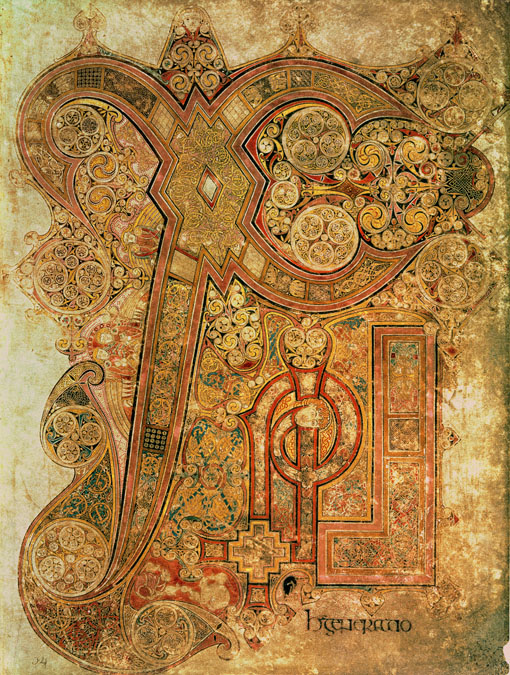
The paragraph discussed in the lecture.The Chi Rho page from the book of Kells.Detail of the Chi Rho page with the rats eating a communion wafer. I can't make out the subject matter myself.
Link to lecture found in comments to
16 Reasons Why James Joyce Is the Greatest Writer Ever, and thanks to
![[livejournal.com profile]](https://www.dreamwidth.org/img/external/lj-userinfo.gif) supergee
supergee for pointing me there. Just for the record, I don't think James Joyce is the greatest writer ever, or at least when I tried reading the paragraph before I posted this, it seemed like occasionally evocative blather.
You will need Real Player to hear the lecture.
![[personal profile]](https://www.dreamwidth.org/img/silk/identity/user.png)